









Every team in your company has an AI use case now: sales team wants a deal-desk assistant, support team wants a FAQ bot trained on the help center, operation team wants document automation. They want it in production yesterday, and they expect IT to make it happen, or they will go around you and buy a tool that does.
So the real question for IT departments isn't whether to build internal AI applications, it's how to build them well. That is to say, applications your team can own, govern, and keep running, without disappearing into a multi-month engineering project for each one.
The short path to success: build the applications, not the platform underneath them.
The thing that blocks most internal AI work isn't the app idea, but everything below it: the orchestration, knowledge retrieval, models, and monitoring has to be reliable before any app is even ready. Build all of that from scratch and you will inherit the full failure rate of enterprise AI. Build your applications on a platform that already provides it, and let your team spends its time on where the value exists.
This is the same lesson behind why AI POCs never reach production and why enterprise AI workflows keep breaking.
Why Building Custom AI Infrastructure Drowns Most Projects
The statistics on AI project failures are sobering and also well documented. S&P Global Market Intelligence's 2025 survey found that 42% of enterprises abandoned most of their AI initiatives, that is up from 17% a year earlier, and that the average organization scrapped 46% of its proof-of-concepts before they reached production. MIT's 2025 Project NANDA report found that only about 5% of enterprise generative AI pilots produced measurable value. And Gartner projected that at least 30% of generative AI projects would be abandoned after proof of concept by the end of 2025.
These are almost never model failures, but the failure modes of hand-built systems. The engineer who built it leaves and it goes undocumented. The requirement shifts and the script proves too brittle to change. IT can't audit it. Output that tested well degrades in production with nothing watching it. Cost runs untracked on a developer's API key. If you build the entire AI stack yourself, you must be prepared to manage every one of these risks for every single app you deploy.
What Production-Grade AI Actually Means
A production-grade internal AI application shares the same properties whether you or your team is building a chatbot, a workflow, or an agent. They are:
Model-agnostic. Logic isn't hardcoded to one provider, so you can switch on cost or compliance.
Explainable. Every user can see what happens to an input, which data it takes, and what the output represents. No black boxes.
Traceable. Every run is recorded and logged: who ran it, when, with what input and output.
Access-controlled. Permissions enforced at the application and knowledge-base level.
Maintainable. Documented, versioned, and transferable if the builder leaves.
These are no longer optional. According to the EU AI Act's high-risk obligations, these are phasing into application (the date is being adjusted under the 2026 Digital Omnibus, but the direction is one-way), and U.S. state laws such as Colorado's are following. Audit trails, explainability, and access control are becoming requirements, not nice-to-haves.
Essential AI Platform Capabilities (So You Don't Have to Rebuild Them)
The reason build the app, not the platform works is that the hard, reusable parts are the same across every application. A good platform provides them out of the box:
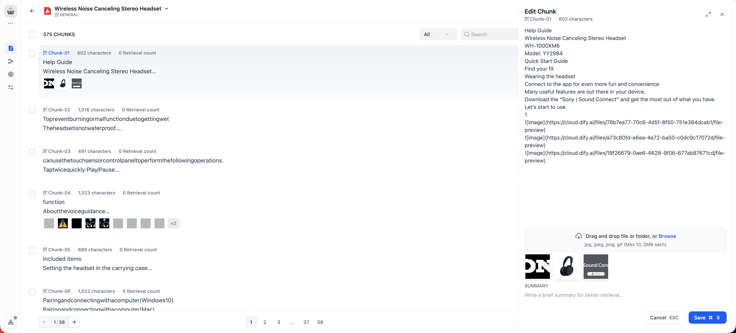
- A model-agnostic foundation. Bring your own keys for OpenAI, Anthropic, Google, and others, and swap models per app without rewriting logic. This is your hedge against vendor lock-in and the single best protection against betting on the wrong model.
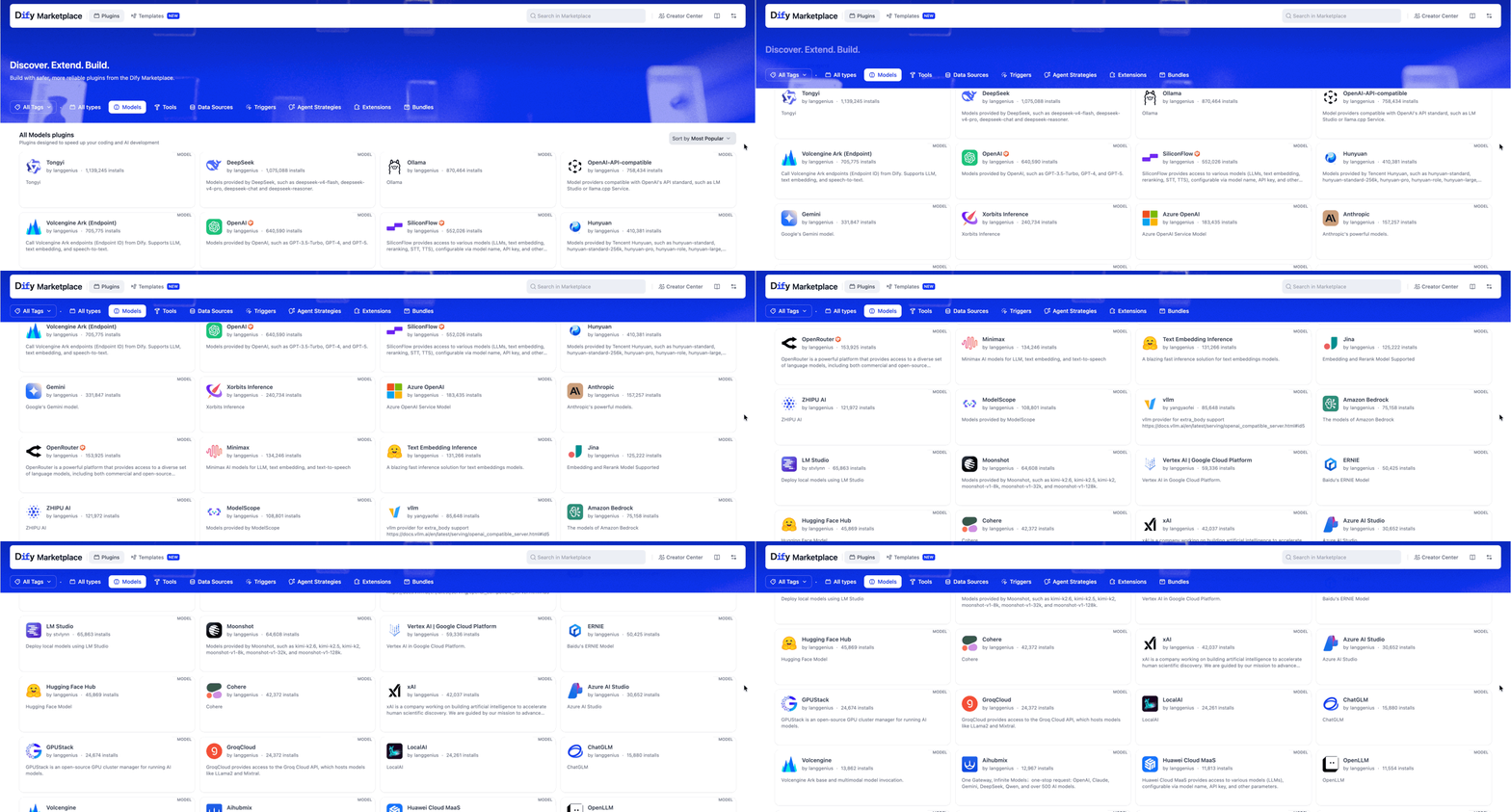
- Built-in RAG. Grounding answers in your company's own documents is the difference between a demo and a trustworthy app. The retrieval pipeline, chunking, embeddings, and scoring should be a built-in capability, not a feature you assemble yourself.
- Visual workflow building. Logic both technical and business reviewers can read, which is what makes a workflow governable instead of a black box.
%%BLOCK:0%% - Observability and access control. Monitoring, logging, and permissions present from day one, not bolted on after an incident.
Managing AI Agents on a Unified Foundation
Autonomous AI agents are simply another type of internal application; they aren't a separate, ungovernable entity. In fact, an agent that autonomously calls external tools and executes multi-step actions requires more traceability and access control, not less.
By building agents on the same platform that manages your standard workflows and chatbots, they automatically inherit the platform's audit trails, permission structures, and model flexibility. This prevents agents from becoming rogue, unexplainable systems within your network.
Dify Cloud: An AI Platform that's Production-ready Since Day One
Dify Cloud is built for exactly this: a platform where IT and business teams build, govern, and run internal AI applications smoothly and securely together. Dify Cloud offers global LLMs, built-in RAG, visual workflows, and observability as native capabilities.
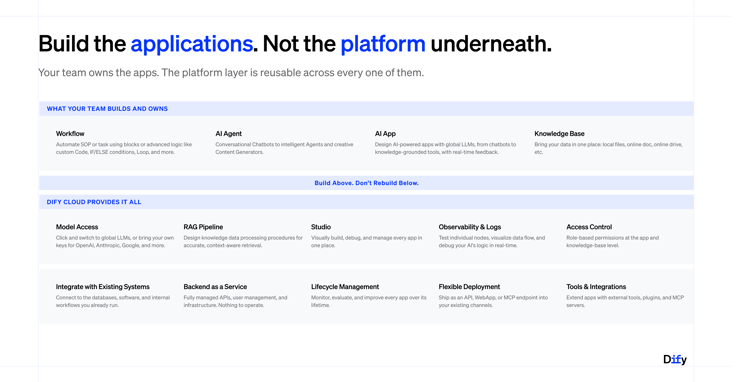
What makes the Dify Cloud the fastest path is that everything is out-of-box. Self-hosting an AI platform means operating a multi-container stack, a database, a cache, a vector store, and worker queues, and tuning it as your knowledge base grows. Dify Cloud removes that entirely. The infrastructure is hosted, updated, and scaled for you, so the only thing your team builds and owns is the applications. You can start free on the Sandbox tier and have a working app in an afternoon, then scale seamlessly as adoption grows across your organiza
Keep ownership of your applications, your proprietary data, and your governance standards, and let the platform layer be our operational responsibility.
The Bottom Line
You don't have to choose between letting business teams run wild with shadow AI tools or turning every simple AI request into a massive IT engineering blocker.
Build the internal AI applications your team truly owns and governs, on a platform you don't have to build everything from the scratch. The teams winning enterprise AI in 2026 aren't the ones who built the most infrastructure. They are the ones who built the highest number of applications that actually reached production, dedicating their valuable engineering time where it delivers compounding business value.
Related articles
- Research
Trust Is a Feature: How Dify Is Governing a Growing Plugin Ecosystem
Security, transparency, maintenance, and the systems behind a marketplace people can rely on.
 Li
Li - Research
How to Reduce AI Costs Without Losing Control of Your Stack
AI cost optimization requires visibility, governance, and reusable workflows to reduce spend without losing control.
 Anne Zhu
 - Research
From AI Experiment to Enterprise Platform: Why Most AI POCs Never Reach Production — And What to Do About It
Most enterprise AI POCs never reach production. This article explains the five key failure modes behind the "production chasm" and presents a practical five-stage framework for moving AI workflows from experiment to reliable, scalable enterprise operations.
 Dify
Dify - Research
Why Enterprise AI Workflows Keep Breaking - How IT Teams Are Finally Fixing It
Enterprise AI workflows fail when adoption outpaces IT governance, fueling Shadow AI risks. Blanket restrictions and point solutions fall short. Leading organizations are adopting centralized AI workflow platforms—shifting IT from gatekeeper to governed enabler—to ensure security, compliance, and scalability.
Dify