











AI is everywhere. From customer support to internal operations, organizations are rapidly adopting AI tools in pursuit of speed, efficiency, and competitive advantage. But when it turns into day-to-day operations, teams are discovering a less glamorous reality: the bill.
AI cost optimization is often framed as managing token consumption, model usages, API expenses, and infrastructure. But it is not merely about tracking usage or reducing spend, it is also about gaining transparency into how AI systems operate, how and where resources are consumed, and how decisions influences cost.
As more organizations are scaling AI adoption, fragmented tooling and black-box consumption make it increasingly difficult to understand where costs are coming from or how to reduce them. For Centralized IT and DevOps teams, the familiar challenge is approaching: supporting innovation without losing operational cost.
The Trap of Black-box AI
Today, many business teams purchase separate AI tools or build ad-hoc automations outside the organization's established IT environment. This ungoverned adoption is often described as Shadow AI.
Shadow AI multiplies coordination costs, creates compliance risks, and drives up AI costs because usage is completely invisible to IT.
A black-box Al environment typically creates these major cost drivers:
- Redundant Model and API Calls
Different teams may build separate applications that perform nearly identical tasks, each making its own model calls and maintaining its own integrations. Without shared visibility, IT cannot identify duplicated usage or consolidate common capabilities. - Vendor Lock-in
Not every task needs the most capable or most expensive model. Classification, extraction, routing, and summarization may be handled effectively by smaller and more economical models. However, teams using closed tools may have limited control over which model performs each task. This makes it difficult to right-size model usage or adapt when requirements, model performance, and pricing change. - Maintenance Overhead
When an AI application fails without accessible execution history or logs, diagnosing the problem becomes slow and expensive. IT may need to reconstruct the application's behavior before it can identify whether the failure came from a model, prompt, tool, integration, or data source.
The less explanable the system is, the more engineering time consumed for each incident. Missing observability also makes it difficult to determine whether an experiment can operate reliably and affordably at production scale, which is one of the recurring reasons of why AI POCs fail to reach production.
Comparison: Fragmented AI vs. Governed AI
Using several AI models of tools has never been the sole core problem, but the lack of ownership is. The missing consistent visibility into how internal AI applications are assembled, operated, and paid for is the issue.
| Area | Fragmented AI Environment | Governed AI Platform |
|---|---|---|
| Ownership | Isolated tools spreading in individual teams | A shared platform with defined roles and access |
| Cost Visibility | Distributed usage and billing across vendors | Consumption can be observed through a dashboard |
| Models | Tied to default or limited models | Models can be switched based on different tasks, costs, and performance |
| Development | Repeatedly building similar applications | Approved workflows, knowledge, and integrations can be reused |
| Troubleshooting | Failures are hard to reproduce or explain | Detailed logs and execution details for diagnosis and optimization |
| Governance | Lack of control and observation for each tool | Standards can be applied across a shared environment |
A governed platform does not require IT to build every application itself. Instead, IT establishes the approved models, tools, data sources, and operational boundaries that other teams can build within.
Governance also needs to be visible in the application itself. A governed AI workflow should be explainable, traceable, maintanable, and independent from any single model provider. We explore these principles in detailed in what a governed AI workflow actually look like.
How Dify Cloud Lowers Costs While Increasing IT Control
Dify Cloud provides a shared space for building, publishing, and tracking AI applications, agents, agentic workflows. IT teams can manage models, tools, knowledge, and orchestration logic all in Dify rather than switching across platforms for scattered applications.
Here is how Dify Cloud helps centralized IT and DevOps teams address the cost above:
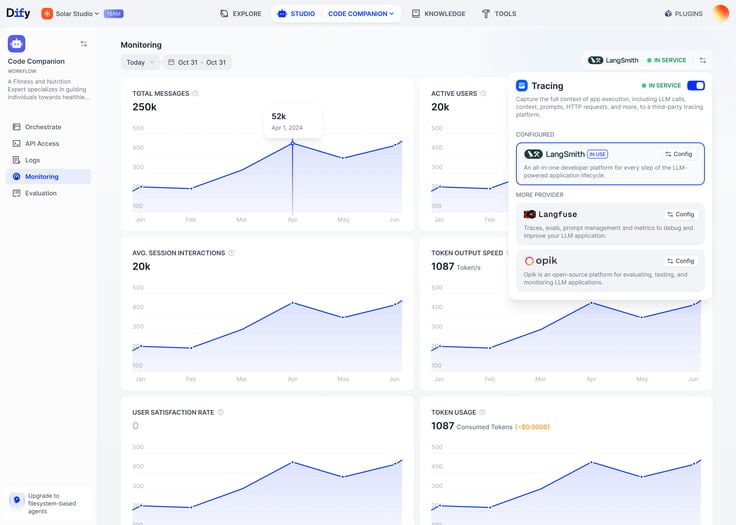
Unified Monitoring and Logs
Stop guessing where your AI budget is going.
Dify provides built-in monitoring that lets you see exactly what the AI does and why. By tracking metrics such as token usage, message volume, and active users per workflow, you can easily identify inefficient processes and optimize them.
This helps IT teams investigate questions such as:
- Which applications are consuming the most tokens?
- Are particular prompts or workflows unnecessarily expensive?
- Where are latency or failure rates increasing?
- Which applications are actively used and worth continuing to maintain?
Instead of treating the model invoice as the first indication of a problem, teams can use operational data to identify inefficient workflows and improve them over time.
The complete and detailed execution logs also give teams dive-in visibility into each run and execution.
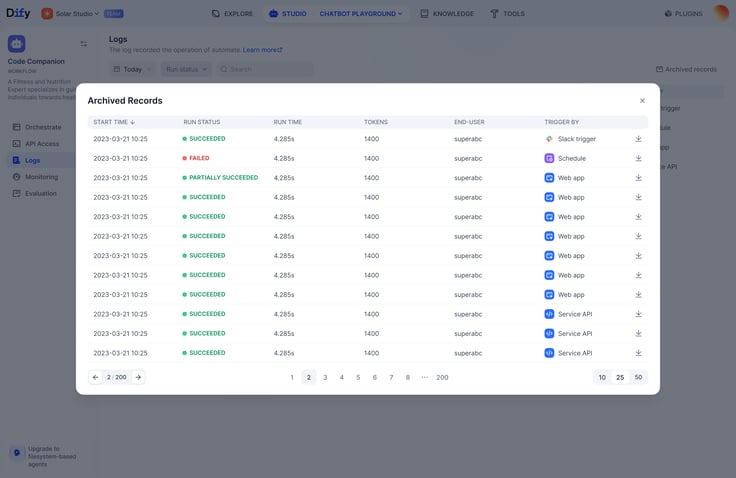
These logs make it easier to trace how a workflow behaves in practice, diagnose issues quickly, and understand where costs are being generated within each step.

Match the Model to the Task
AI cost control doesn't mean adopting the cheapest model everywhere. It means choosing the appropriate model for each task.
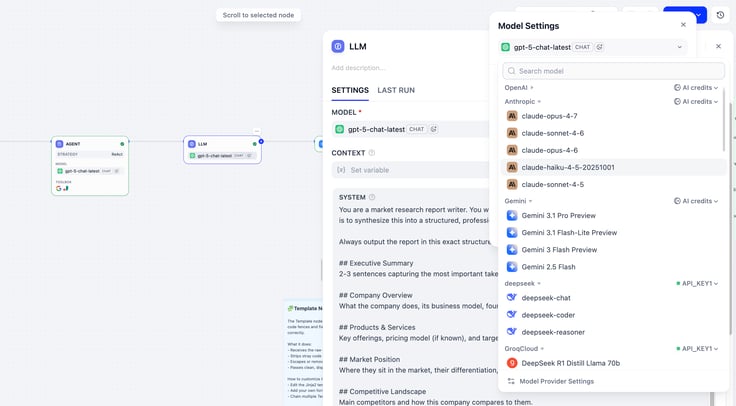
Dify is model-agnostic, which means you can choose and configure different model providers, such as, OpenAI, Anthropic, Google, and open-source models for different nodes whithin the same workflow. Route simple internal tasks to cheaper models in one workflow, saving massive API costs without rewriting the application.
Since the workflow logic is saved on the canvas, so teams can test or switch the models for performance, token usage, latency comparisons without rebuilding the entire application around a new model provider. This reduces dependence on a single model provider and gives greater flexibility for business and IT teams to balance quality, latency, and cost.
Build Once and Reuse Across Teams
With Dify, teams can combine visual workflows, models, tools, and knowledge retrieval into reusable applications. Existing knowledge bases can be connected to workflows so teams can build applications grounded in approved organizational information rather than creating separate data pipelines for every use case.
Applications can also be duplicated, or exported and imported through Dify's DSL format, allowing teams to share approved workflow logic between workspaces or adapt it for another business unit.
Cost Optimization is an Operating Model
Reducing AI costs is not only a matter of negotiation of lower model prices or shortening prompt. They simply address individual transactions.
The larger opportunity is operational. When AI applications are fragmented across departments, organizations pay for duplicated consumption, development, and maintenance. When those applications are built on a shared and observable platform, teams can choose appropriate models, reuse proven workflows while IT can monitor related metrics for further optimization.
Related articles
- Research
Trust Is a Feature: How Dify Is Governing a Growing Plugin Ecosystem
Security, transparency, maintenance, and the systems behind a marketplace people can rely on.
 Li
Li - Research
Build AI Applications, Not Platform Underneath: A Guide for IT Leaders
Here's how to build internal AI applications that reach production and survive the real world, without building the platform underneath them from scratch.
 Dify
Dify - Research
From AI Experiment to Enterprise Platform: Why Most AI POCs Never Reach Production — And What to Do About It
Most enterprise AI POCs never reach production. This article explains the five key failure modes behind the "production chasm" and presents a practical five-stage framework for moving AI workflows from experiment to reliable, scalable enterprise operations.
Dify - Research
Why Enterprise AI Workflows Keep Breaking - How IT Teams Are Finally Fixing It
Enterprise AI workflows fail when adoption outpaces IT governance, fueling Shadow AI risks. Blanket restrictions and point solutions fall short. Leading organizations are adopting centralized AI workflow platforms—shifting IT from gatekeeper to governed enabler—to ensure security, compliance, and scalability.
Dify