












What is AI agent Management Platforms
AI agent management platforms are centralized software platforms that help organizations oversee AI agents across different deployment environments. According to Gartner, they bring together security, governance, and FinOps controls for both custom-built agents and agents acquired through marketplaces. These controls help organizations manage agent deployments, track spending, and assess return on investment.
Three related concepts help explain their role:
- AI agents use models, data, and tools to carry out tasks.
- AI agent management is the ongoing practice of defining what agents should do, assigning responsibility, controlling access, and reviewing results.
- AI agent management platforms provide the software to apply those practices consistently across teams.
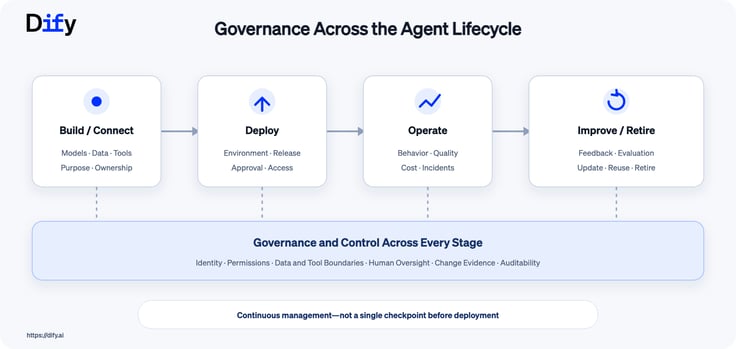
This management starts before deployment and continues through operation, updates, and retirement. The platform helps teams maintain visibility and control throughout that lifecycle.
Why do Enterprises Need AI Agent Management?
AI agents are becoming part of enterprise operations.
According to Gartner's 2026 CIO and Technology Executive Survey, 17% of organizations had deployed AI agents, while more than 60% expected to deploy them within two years. Yet oversight is struggling to keep pace: IBM's 2026 technology leader study found that 77% of surveyed organizations reported AI adoption outpacing their governance capabilities. As agents take on business tasks, enterprises need to understand what they can access, what they actually do, and who is responsible for the results. Three challenges make this management essential.
1. Agents work across systems.
A customer support agent might retrieve customer records, check an order, and request a refund within one task. Each action involves different data and permissions. Teams need to oversee the complete task alongside the individual systems involved.
2. Agent behavior can change over time.
Updates to a model, instructions, a knowledge base, or a connected tool can affect an agent's results. An agent that performed well during testing may need reassessment after those changes. Monitoring whether it runs successfully is only part of the job; Teams also need to check whether its actions and outputs remain appropriate.
3. Adoption spreads across teams.
As departments create their own agents, organizations can accumulate overlapping capabilities, unclear ownership, unused permissions, and costs that are difficult to attribute. This growing challenge, known as AI agent sprawl, makes local oversight harder to coordinate across the business. Gartner has also highlighted the risks of agent sprawl and the need for clearer governance, agent inventories, and lifecycle controls.
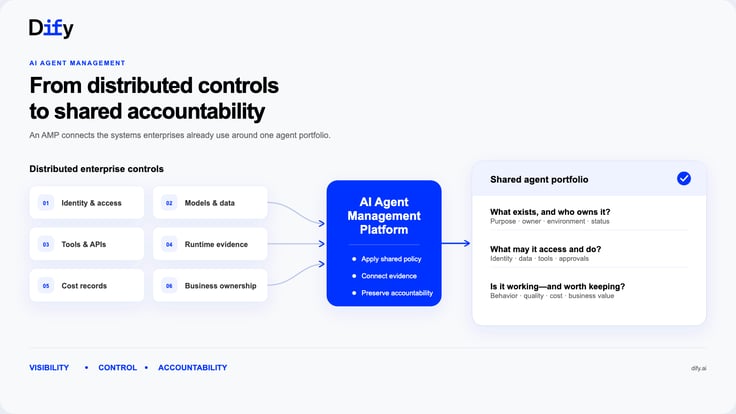
The need becomes clear when teams struggle to answer basic questions: Which agents are active? Who owns them? What can they do? Are their results worth the cost? A shared management approach helps organizations answer those questions and decide where stronger controls or dedicated platform capabilities are needed.
What do AI Agent Management Platforms do?
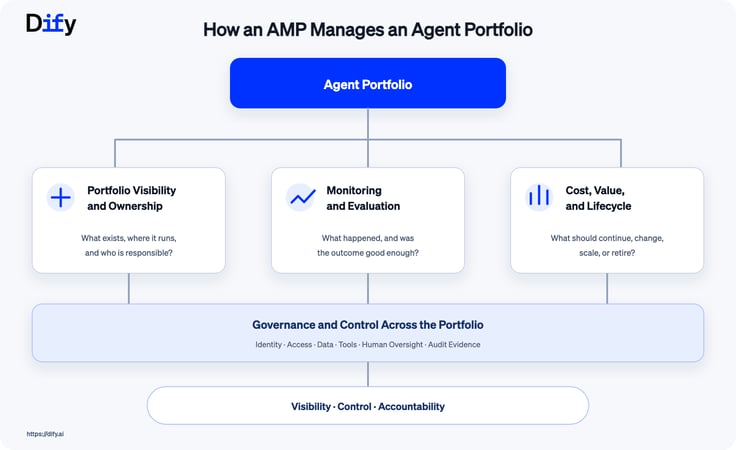
AI agent management platforms support five core areas of oversight. Their capabilities vary, especially for agents built or deployed outside their own environment.
Agent Inventory and Ownership
A shared inventory records each agent's purpose, owner, deployment environment, and status. It helps teams identify duplicate capabilities, find agents worth reusing, and address those without clear ownership.
Governance and Access Controls
Platforms help control who can create, modify, publish, and use agents, and which data and tools each agent can access. They can also enforce approval requirements and retain audit records—for example, requiring human approval for refunds above a set amount.
Monitoring and Evaluation
Monitoring shows what an agent did, including tool calls, errors, and execution time. Evaluation checks whether the result was accurate, safe, and useful. Together, they help teams identify failures and understand what needs improvement.
Cost and business value
Platforms help attribute spending to agents, teams, or tasks. Comparing that spending with quality and business outcomes helps teams decide where to invest. Cost per successfully resolved request, for example, is more informative than model usage alone.
Lifecycle and Change Management
Platforms support oversight through testing, deployment, updates, and retirement. Version records and release controls help teams review changes and recover when performance declines. Regular reviews inform decisions to expand, restrict, or retire an agent.
How Does Agent Management work in Practice?
Consider a customer support agent that checks orders and handles refund requests. These are several capabilities that support its operation:
| Capability or tool | Primary question |
| Agent builder or framework | How do we create the agent? |
| Orchestration | How are tasks, tools, and agents coordinated during execution? |
| AgentOps and observability | How do we test, inspect, and improve agent operation? |
| Agent management platform | How do we oversee agents across teams and environments? |
These capabilities often overlap within a product. The distinction is between their purposes, rather than fixed product categories.
For the refund agent, management begins with assigning responsibility. The support team defines refund policies and service goals, while the technical team maintains the agent and its integrations. Before deployment, teams limit access to relevant customer and order data, test the workflow, and require human approval for refunds above a defined amount.
During operation, teams review tool calls, errors, and approval records alongside resolution quality and cost per resolved request. A completed refund confirms execution; reviewing it against policy helps establish whether the decision was appropriate.
When policies or connected tools change, teams test the affected workflow before releasing an update. A management platform helps connect ownership, controls, and operational evidence, while people remain responsible for business decisions and acceptable risk.
How to Evaluate an AI Agent Management Platform
Use this checklist during a platform demo or pilot. Mark which requirements are essential for your organization, then record what you can verify.
| Evaluation area | What to check | Essential? | Assessment | Evidence or limitations |
| Agent coverage | Supports the agents and deployment environments we use, including agents built elsewhere. | ☐ | ||
| Control depth | Clearly distinguishes which agents it can register, monitor, and actively control. | ☐ | ||
| Access controls | Enforces the data and tool permissions our agents require. | ☐ | ||
| Human approval | Pauses actions requiring approval and records the decision. | ☐ | ||
| Ownership | Records an accountable owner, purpose, and status for each agent. | ☐ | ||
| Monitoring and evaluation | Provides execution records and supports assessment of result quality. | ☐ | ||
| Cost visibility | Attributes spending to agents, teams, or tasks for comparison with outcomes. | ☐ | ||
| Change and recovery | Supports testing, version tracking, and a practical way to pause or recover from a faulty release. | ☐ | ||
| Enterprise integration | Connects to our identity, security, and operational systems with manageable maintenance effort. | ☐ |
Assessment options: Meets | Partly Meets | Does not Meet | Not Verified
A platform is a stronger fit when it meets your essential requirements with demonstrated evidence. Review partial support and unverified claims individually; A high number of checked items should not outweigh a critical gap.
AI agent management brings ownership, access controls, and performance evidence together. As adoption grows, a platform can help teams apply these practices consistently across the organization.
Start by reviewing the agents you already have: who owns them, what they can access, and whether their results justify their cost. Those answers will help you identify the management capabilities your organization needs next.
Related articles
- Company
Dify Recognized in Gartner®’s First Magic Quadrant™ for AI Agent Management Platforms. What It Means to Us.
Dify's inclusion in Gartner's first Magic Quadrant for AI Agent Management Platforms marks a new chapter in our enterprise platform strategy.
 Anne Zhu
- Research
Trust Is a Feature: How Dify Is Governing a Growing Plugin Ecosystem
Security, transparency, maintenance, and the systems behind a marketplace people can rely on.
 Li
- Research
How to Reduce AI Costs Without Losing Control of Your Stack
AI cost optimization requires visibility, governance, and reusable workflows to reduce spend without losing control.
Anne Zhu - Research
Build AI Applications, Not Platform Underneath: A Guide for IT Leaders
Here's how to build internal AI applications that reach production and survive the real world, without building the platform underneath them from scratch.
 Dify