












AI applications are moving quickly from simple chatbots to systems that can search, reason, recommend, summarize, and act on live business data. For developers, that usually means wiring together databases, embedding models, vector search, rerankers, orchestration logic, and application code. For no-code AI builders, it often means waiting for those integrations to exist before an idea can become a working prototype.
This is exactly the gap Dify was built to close. Through our partnership with MongoDB, two new plugins are now live on Dify Marketplace: MongoDB Atlas and Voyage AI. Together, they let Dify builders visually compose AI workflows and agents that connect directly to MongoDB data, perform semantic retrieval with Atlas Vector Search, sharpen result quality with Voyage AI embeddings and reranking, and optionally interact with operational documents through controlled database tools.
The result is a practical path from idea to working AI application: less custom orchestration code, more reusable building blocks, and a smoother experience for both developers and visual builders.
Why Dify and MongoDB Belong Together
Dify is the orchestration layer where AI applications come together. Workflows, agents, prompts, tools, and user interactions all get composed visually on the same canvas. To turn that orchestration into something genuinely useful for business teams, two things matter beyond the LLM itself: the data your agents can reach, and the precision of what they retrieve.
That is exactly where MongoDB Atlas and Voyage AI now slot directly into Dify workflows. Atlas brings the data foundation, including flexible documents, operational queries, aggregation, full-text search, and vector search in one platform. Voyage AI sharpens the retrieval with embeddings for semantic search and reranking for precision.
Inside Dify, the pattern becomes simple and reusable. Dify orchestrates the AI experience. MongoDB Atlas stores and retrieves the data. Voyage AI improves retrieval quality. For a visual builder, that means assembling a retrieval-augmented generation workflow without writing a backend. For a developer, it means the integration points arrive as packaged plugin nodes rather than one-off glue code.
Meet the MongoDB Plugins on Dify Marketplace
The MongoDB partnership brings two complementary plugins to Dify Marketplace.
MongoDB Atlas Plugin
Inside Dify, the MongoDB Atlas plugin shows up as a set of ready-to-use tools that workflows and agents can call directly from the workflow canvas.
Available capabilities include:
- Finding documents
- Running aggregation pipelines
- Performing Atlas Vector Search
- Performing full-text search
- Inserting documents
- Updating documents
- Deleting documents
This is useful for more than just retrieval. It enables Dify agents that can inspect data, summarize records, recommend actions, and when safely configured, update operational collections.
For example, a project management agent can search a database of team members, skills, previous projects, and availability, then recommend the best team for a new initiative. With carefully scoped permissions, that same agent could also update a draft team assignment or write a recommendation record back to MongoDB.
Voyage AI Plugin
Inside Dify, the Voyage AI plugin adds two key nodes to your workflow: embedding and reranking.
Embeddings convert text into vectors so MongoDB Atlas Vector Search can find semantically similar documents. Reranking takes an initial set of retrieved documents and reorders them by relevance to the user's query.
That two-step retrieval pattern matters. Vector search is excellent for finding likely candidates quickly, while reranking helps surface the best candidates before the final answer is generated or returned. In a Dify workflow, both steps live as visible, tunable nodes you can inspect and adjust without leaving the canvas.
The MongoDB-RAG Template
The included MongoDB RAG template demonstrates how these plugins work together in a Dify workflow.
At a high level, the pipeline does the following:
- Accepts user input
- Embeds the query with Voyage AI
- Searches MongoDB Atlas using Atlas Vector Search
- Reranks the retrieved documents with Voyage AI
- Formats the results into a prompt-ready output
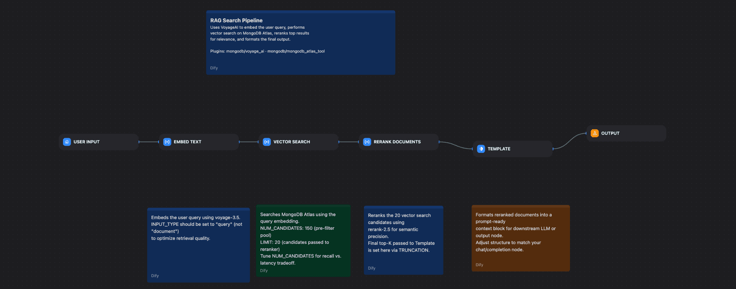
This is the core pattern behind many production-grade RAG systems.
Instead of sending a user question directly to an LLM and hoping the model already knows the answer, the workflow first retrieves relevant information from MongoDB. The retrieved context can then be used by a downstream answer node, chat model, or agent to produce a more grounded response.
How the Workflow Works
The MongoDB RAG workflow is intentionally simple and reusable. It separates each retrieval step into a dedicated node so builders can understand, tune, and replace parts of the pipeline as needed.
1. User Input
The workflow starts with a text input. This could be a question, a search phrase, a support request, a project description, or any natural-language query.
Example:
What would be a good team to build scalable Rust applications?
2. Embed the Query
The input is sent to the Voyage AI embedding tool. The embedding model converts the text into a vector representation that captures semantic meaning.
For search use cases, the embedding input type should be optimized for queries. This helps improve retrieval quality because the model understands that the text represents a search intent rather than a document to be indexed.
3. Search MongoDB Atlas
The generated query vector is passed to the MongoDB Atlas Vector Search tool. Atlas compares the query vector against document embeddings stored in a MongoDB collection and returns the nearest semantic matches.
The template uses two important retrieval settings:
numCandidates: how many approximate nearest-neighbor candidates Atlas considers before returning final results.limit: how many results are passed forward to the next step.
Increasing candidates can improve recall, while lowering them can reduce latency. This gives builders and developers a clear tuning knob depending on the application’s needs.
4. Rerank the Results
The top vector search results are then sent to the Voyage AI reranking tool. Reranking compares the original user query against each candidate document and sorts the documents by relevance.
This step is especially valuable when the first-stage vector search returns many plausible matches. Reranking helps the workflow prioritize the documents most likely to answer the user’s actual question.
5. Format the Output
Finally, the template node formats the reranked documents into a structured output. That output can be returned directly, or it can become context for a downstream LLM answer node.
This makes the template flexible. It can be used as a standalone search pipeline, or as the retrieval layer inside a larger Dify chatbot, workflow, or agent.
What No-Code AI Builders Can Create
For no-code builders, the biggest advantage is composability. Instead of implementing a RAG backend from scratch, you can drag tools into a Dify workflow and connect them visually.
With these plugins, builders can create:
- Knowledge-base assistants that answer questions from MongoDB documents
- Support copilots that search prior cases and recommend resolutions
- Project management agents that recommend teams based on skills and history
- Document search apps that combine semantic and full-text retrieval
- CRM or account assistants that retrieve relevant customer information
- Operations agents that read from MongoDB and create structured recommendations
The same building blocks can support simple workflows or more autonomous agents. A workflow might only retrieve and format context. An agent might decide when to search, when to aggregate, and when to update a document — depending on the tools you enable.
What Developers Get
Developers still benefit from the visual experience, but the value goes deeper.
These plugins reduce the amount of custom integration code required to connect Dify with MongoDB Atlas and Voyage AI. Instead of hand-building every request, response parser, embedding call, and database operation, developers can rely on packaged tools with clear inputs and outputs.
The architecture also follows a clean separation of concerns:
- Embedding is handled by the Voyage AI embed tool.
- Retrieval is handled by MongoDB Atlas Vector Search.
- Precision tuning is handled by the Voyage AI rerank tool.
- Formatting is handled by the Dify template node.
- Application behavior is handled by Dify workflows or agents.
That separation makes the system easier to debug and extend. Developers can tune vector search without changing reranking. They can swap embedding models without rewriting MongoDB logic. They can add an LLM answer node without changing the retrieval pipeline.
Example: A Project Management Agent
One example use case is a project management agent that recommends a team for a new project.
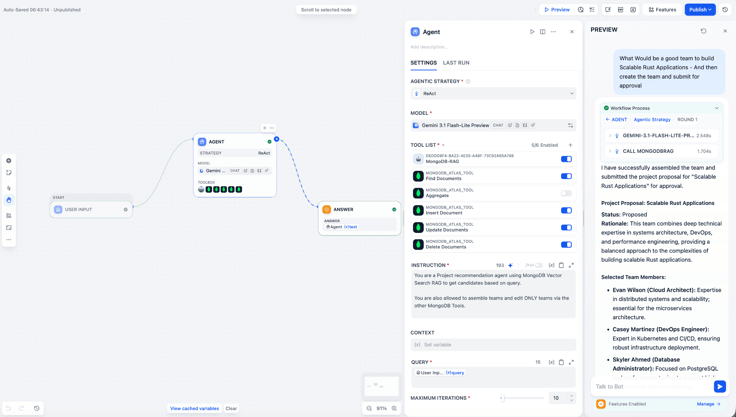
A user might ask:
What would be a good team to build scalable Rust applications?
The agent can use semantic search to find relevant candidates, previous projects, skills, and experience stored in MongoDB. It can then assemble a recommendation that explains why each person fits the project.
In a Dify agent setup, MongoDB tools can be made available alongside the RAG workflow. The agent can search documents, inspect structured records, run aggregations, and produce a recommendation grounded in database results.
This pattern is useful because business data is rarely just static documentation. It often includes operational records: people, cases, accounts, tickets, projects, tasks, products, and events. MongoDB allows that data to remain flexible and queryable, while Dify makes it accessible to AI workflows and agents.
Best Practices for Building with These Plugins
To get the best results, keep a few practical guidelines in mind.
Use the Right Embedding Mode
When embedding user questions for retrieval, use query-optimized embeddings. When embedding documents for storage, use document-optimized embeddings if the model supports it. This improves the alignment between search queries and indexed content.
Tune Vector Search for Recall and Latency
Atlas Vector Search settings such as numCandidates and limit affect both result quality and performance. A larger candidate pool can improve recall, but may increase latency. Start with sensible defaults, then tune based on your dataset and user experience goals.
Rerank Before Generating
Reranking helps improve the quality of the context that reaches the final model. This can reduce irrelevant context, improve answer accuracy, and make the final output easier to trust.
Scope Write Tools Carefully
MongoDB insert, update, and delete tools are powerful. When exposing them to agents, use careful scoping, clear instructions, and appropriate permissions. Many applications should start with read-only tools, then add mutation capabilities only when the workflow and safety boundaries are well understood.
Keep Indexes Aligned with Your Data
For vector search, the Atlas index should match the embedding field and embedding dimensions used by your model. For full-text search, index the fields users are likely to search. Good indexing turns a promising prototype into a responsive application.
Why This Matters
The deeper value of this partnership is not that Dify can call MongoDB or Voyage AI. It is that the entire retrieval and data-interaction pattern of an AI application now lives inside one place: Dify. Builders no longer have to choose between visual speed and production-grade data infrastructure. They get both, composed on the same canvas, reusable across every app they build.
For visual builders, this means faster experimentation and fewer blockers. For developers, it means a cleaner integration surface and less repetitive orchestration work.
Conclusion
The MongoDB Atlas and Voyage AI plugins make Dify a stronger platform for building data-aware AI applications, approachable for visual builders and credible for developers.
The template shows the foundation: embed a query, retrieve relevant documents from MongoDB Atlas, rerank them, and format the result. From there, teams can build knowledge assistants, recommendation agents, support copilots, document search experiences, and operational AI workflows.
Dify is where AI applications come together. With MongoDB Atlas and Voyage AI now available as native workflow components, teams can build RAG systems and data-aware agents that stay connected to real business data from day one.
Get started today
Browse the MongoDB plugins on Dify Marketplace, drop them into a workflow, and start building data-aware agents in minutes.
About MongoDB
MongoDB is a leading developer data platform that empowers developers to build, scale, and modernize applications faster. Headquartered in New York, MongoDB provides an integrated suite of cloud database services centered around its pioneer document modal.
At the core of its ecosystem is MongoDB Atlas, a fully managed multi-cloud developer data platform designed to handle both operational workloads and advanced AI applications in a single unified architecture. By natively integrating flexible JSON-like documents, powerful aggregation pipelines, full-text search, and multi-cloud Atlas Vector Search, MongoDB removes the operational complexity of managing disparate database systems.
Trusted by millions of developers and thousands of customers globally—ranging from disruptive startups to the world's largest enterprises—MongoDB provides the scalable, secure, and highly resilient data foundation required to power the next generation of data-aware, intelligent applications.
Website | MongoDB Atlas | Docs | Github
About Dify
Dify is an open-source, production-ready platform for building agentic AI applications. It empowers enterprises and developers to rapidly build, deploy, and operate generative AI applications through an intuitive low-code interface.
As of January 2026, Dify has surpassed 142k stars on GitHub, establishing itself as one of the most recognized open-source generative AI projects in the world.
Built around core capabilities including workflow orchestration, agent frameworks, data management, and model integration, Dify significantly lowers the barrier to adopting advanced AI technologies. Whether you're an independent developer or part of a large organization, Dify enables teams to harness generative AI in a more cost-effective and sustainable way, driving scalable value across operational automation, knowledge services, customer support, and intelligent analytics.
Related articles
- Product
Dify x Sonilo: Give Your Video Workflows a Licensed Soundtrack
Turn finished videos into soundtracked outputs with Sonilo on Dify. Generate licensed music and sound effects matched to each cut, all within the same workflow.

 Sonilo & Dify
 - Product
From Discovery to Response: A More Connected Dify Marketplace
Good work goes further with better ways to find it, build with it, and share what you learn
 Yajing Wang
 - Product
Why We Redesigned Dify's Agent?
Discover how we redesigned Agent, and how we came to see agents and workflows not as isolated components, but as collaborators that support daily work.
Dify - Product
From Logs to Evidence: Asqav Joins Dify Marketplace to Make Every Agent Action Verifiable
Dify Agents can now produce verifiable, tamper-evident receipts for actions routed through Asqav, our ecosystem partner now live on Dify Marketplace.
 Asqav & Dify