











Designing Intent-Based Email Routing with Dify Workflow
Dify uses workflow-based intent routing to automatically classify and assign support emails while keeping decisions controlled and auditable. This approach improves routing consistency and helps support teams scale operations without losing stability.

A Perspective for Support and Operations Leaders
As product adoption grows, support teams rarely struggle with effort — they struggle with scale. We experienced this shift firsthand within the Dify Support team. In the early stages, response times remained acceptable, tickets were resolved efficiently, and the team appeared productive on the surface.
Gradually, however, the structural tension became clear. Before solving problems, we were spending increasing amounts of time deciding who should solve them. Manual triage quietly became an invisible tax on productivity, consuming operational capacity without appearing in any dashboard. At that point, inbox management stopped being a coordination task and started becoming an operational design issue.
The Hidden Operational Risk
As ticket volume increased, routing decisions naturally became less consistent. Within our own team, one person might classify an email as billing, another as technical, and a third might forward it multiple times before ownership was clarified. While manageable at low volume, this inconsistency compounds rapidly at scale.
Emails begin bouncing between teams, sensitive cases risk unnecessary delay, accountability becomes blurred, and SLA metrics start fluctuating. We realized that the problem was not response speed — it was routing consistency: the ability to ensure that similar issues are assigned predictably, regardless of who happens to be on shift.
For support and operations leaders, that predictability is operational stability.
Why Traditional Automation Was Not Enough
Within the Dify Support team, our first attempt at solving this was rule-based routing. Keyword logic gave us control and transparency, but it lacked adaptability. As customer language evolved and new product scenarios emerged, maintaining routing rules became a continuous operational burden rather than a scalable solution.
At the other extreme, a fully autonomous AI agent introduced a different risk. Allowing a model to independently interpret and execute routing decisions felt unpredictable — and in environments handling billing disputes, compliance matters, or security reports, unpredictability is unacceptable.
What became clear to us was this: support leaders do not need creativity in routing decisions; they need controlled interpretation.
That realization ultimately shaped our architecture.
Why We Chose Dify Workflow
Dify Workflow allowed us to formalize routing logic while introducing bounded intelligence. Instead of letting AI operate freely, we embedded it at a controlled checkpoint inside a deterministic workflow.
- The workflow defines structural branches.
- The model provides intent interpretation within predefined categories.
- Final routing decisions remain rule-driven and observable.
This separation ensures that intelligence improves decision quality without weakening operational safeguards. For leaders responsible for reliability, that balance is essential.
Case Study: Rebuilding First-Pass Routing
In our own support operations, we redesigned inbox triage as a structured workflow.
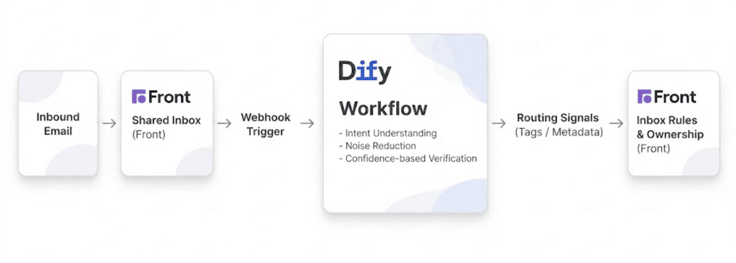
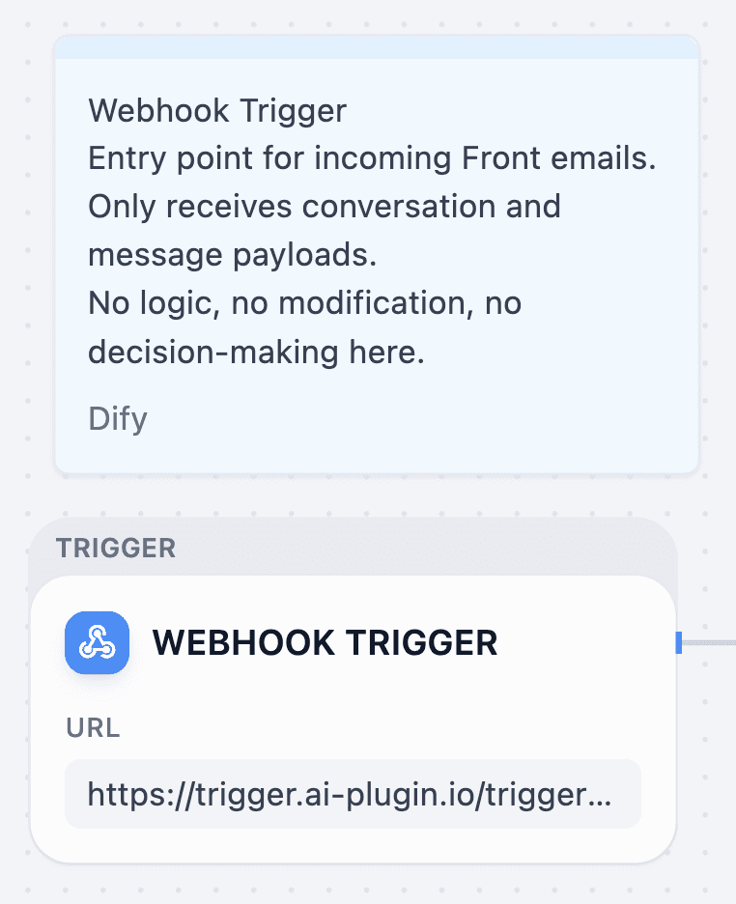
- Trigger & Signal Capture
Every inbound email triggers the workflow automatically. Metadata and raw content are captured immediately to ensure reliable data input.
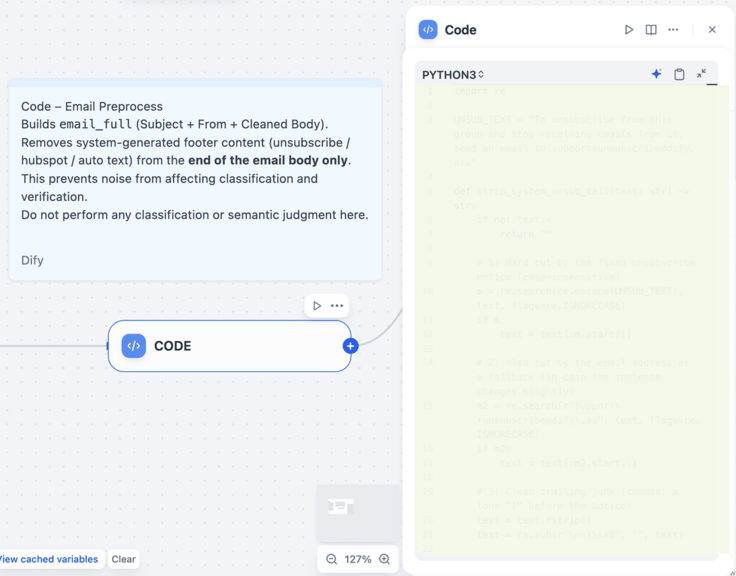
- Context Cleaning
Before classification, signatures, unsubscribe links, and forwarded thread history are removed. Only the most recent user-authored message is retained. This significantly improves routing stability by reducing noise.
- Controlled Intent Interpretation
An LLM acts as a routing analyst at a fixed node. It selects from a predefined category set and returns intent, confidence, and structured verification. The taxonomy remains fixed within the workflow.
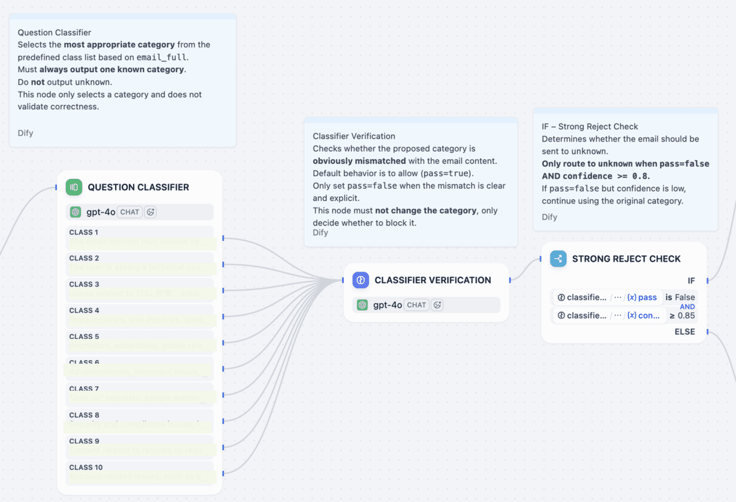
- Guarded Routing Logic
High-confidence, non-sensitive cases are routed automatically. Sensitive or low-confidence cases enter a review path. Interpretation is model-based; execution remains deterministic.
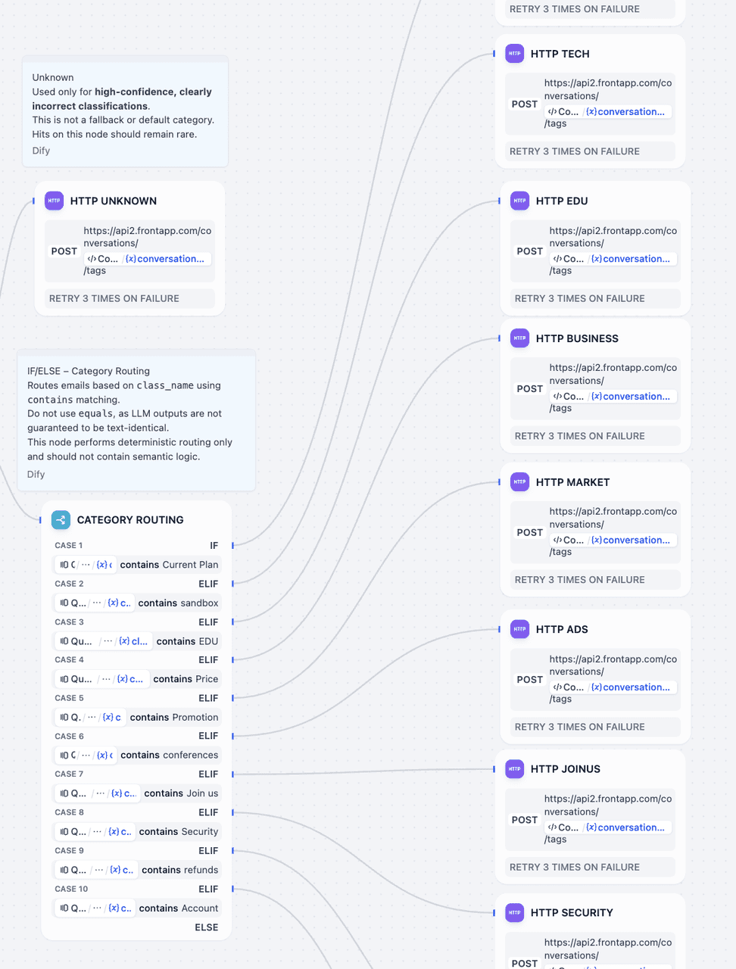
- Action & Audit
Routing results are passed to downstream systems, and a full audit trail is retained. Every decision remains visible and traceable.
The Operational Impact
Following implementation within the Dify Support team, the operational shift became measurable. Approximately 85% of inbound emails are now routed automatically, with manual triage limited to genuine edge cases rather than routine categorization. Routing behavior remains consistent across team members, significantly reducing the variability that previously depended on individual interpretation.
As a result, rule maintenance overhead has decreased substantially, and ownership assignment has become predictable rather than situational. For a support leader, that predictability translates directly into reduced operational noise, improved team focus, and greater clarity in accountability. Instead of spending time coordinating handoffs, the team can concentrate on solving customer issues.
What This Means for Support and Operations Leaders
Scaling support operations is not simply about handling increased ticket volume; it is fundamentally about stabilizing decision processes. When routing depends on individual interpretation, growth inevitably introduces variability. However, when routing logic is embedded within a structured and observable workflow, growth introduces efficiency instead of chaos.
Intent-based routing, when designed with clearly defined boundaries and governance, evolves from an automation feature into operational infrastructure. For leaders responsible for reliability, consistency, and accountability, that distinction is not theoretical — it directly shapes the stability and scalability of their organization.
Getting Started
If these scaling challenges feel familiar, the next step is not rebuilding your infrastructure — it is introducing structure into your routing decisions.
Within the Dify Support team, we implemented this pattern using a structured workflow that separates intent interpretation from routing logic. We’ve shared the same architecture as a reusable Dify Workflow DSL template.
After importing, teams typically adapt the trigger to their email system, define internal routing categories, and connect the HTTP node to their ticketing or CRM platform. Most organizations can deploy a stable version within two to three weeks, depending on integration complexity.
The goal is not automation for its own sake — it is routing predictability. And at scale, predictability becomes operational stability.
Related articles
- How to
AI Agent or Workflow? How to Choose the Right Approach
Learn when an AI agent is a good fit, when a workflow is more reliable, and how IT teams can test and govern either approach.
 Anne Zhu
 - How to
How to Create an AI Shopping Agent that Boosts Your Ecommerce Store
From catalog scraper and personalized recommendations to qualified lead capture, learn how to build an AI agent for your online store with Dify.
 Alex
Alex - How to
I Patched Calendly with New Agent
Use an Agent to make the software you already rely on work the way you work without rebuilding the whole thing.
Alex - How to
How to Build Your First Agent in Dify
Learn how to build an agent in Dify without coding or learning all the technical details. Create an agent, customize it through chatting, and use it as a standalone app or add it to the workflow.
Anne Zhu